October 4, 2025 · 6 min read
Fall Furnace Tune-Up Checklist for Desert Homes
Your Phoenix furnace runs about 50 hours a year, then sits idle for 300 days. That's exactly why fall pre-season service matters — here's what should be on the ticket.
Phoenix furnaces have an unusual failure mode. They sit unused for eight or nine months, then get asked to run reliably during the exact three-week stretch when overnight lows drop into the 30s and every homeowner in the Valley calls at once. Rodents, dust, corrosion, and dried-out ignition components all take their toll during the idle season. A real fall tune-up is not a filter change and a courtesy vacuum — here's what should actually happen on the ticket before we sign it and leave.
Do I really need a furnace tune-up in Phoenix?
Yes — precisely because you use it so little. Most Phoenix homes log 40 – 60 hours of runtime a year on the furnace, versus 1,800 – 2,400 hours on the AC. Low usage isn't the friend it sounds like: idle equipment gathers dust in the burner assembly, ignitor coatings crack, gas valve diaphragms stiffen, and rodents love the warmth of a still furnace cabinet. First cold night in December is a bad time to discover any of that.
A pre-season inspection catches the ignitor before it snaps mid-cycle, verifies combustion is clean before you're breathing it for a week, and gets your name on the schedule ahead of the December rush when nobody has next-day availability.
What should a real tune-up actually include?
Digital combustion analysis. This is non-negotiable. A calibrated analyzer in the flue measuring carbon monoxide, oxygen, and stack temperature is the only way to prove the furnace is burning safely and efficiently. If your technician doesn't pull out an analyzer, you got a filter change, not a tune-up.
Beyond combustion, the ticket should list: heat exchanger inspection (bore scope, not a flashlight), gas manifold pressure verified against the nameplate, ignitor resistance measured in ohms, flame sensor cleaned and microamp draw checked, blower motor amp draw and capacitor microfarads tested, flue draft measured, and temperature rise across the heat exchanger verified against the manufacturer's range.
When should I schedule it?
October, before the first real cold snap. In the Valley the first night that pulls a furnace call is usually the second or third week of November. By early December, response times stretch to four or five days for non-members and every technician is triaging no-heat emergencies. October gets you a two-hour appointment window and unhurried work.
There's a diagnostic reason for October too, not just a scheduling one. Daytime highs are still in the 90s, so we can run the furnace through four or five full heat cycles back to back and watch how it behaves warm — and the house recovers on its own an hour after we leave. Catching a lazy ignitor or a heat exchanger that only leaks once it's up to temperature takes repeated cycling. Doing that same test in January, in a house that's already cold, is a far bigger imposition on you.
How long should the technician be on-site?
A real tune-up is 60 to 90 minutes of active work on the equipment. Anything under 30 minutes means someone changed the filter and moved on. If the invoice is under 40 minutes and doesn't list a combustion analysis reading with actual numbers, you didn't buy what you paid for — call the office and ask for those numbers before you pay.
Insist on the numbers rather than the checkmarks. An invoice that says "combustion tested — OK" tells you nothing you can act on. A real one records carbon monoxide in parts per million, stack temperature, manifold gas pressure in inches of water column, and the measured temperature rise checked against the range stamped on the furnace's own data plate. Those figures are the whole point: they're what lets next year's technician — or you — see whether the unit drifted, and how far, instead of starting from scratch every October.
What are the warning signs I shouldn't wait for the tune-up?
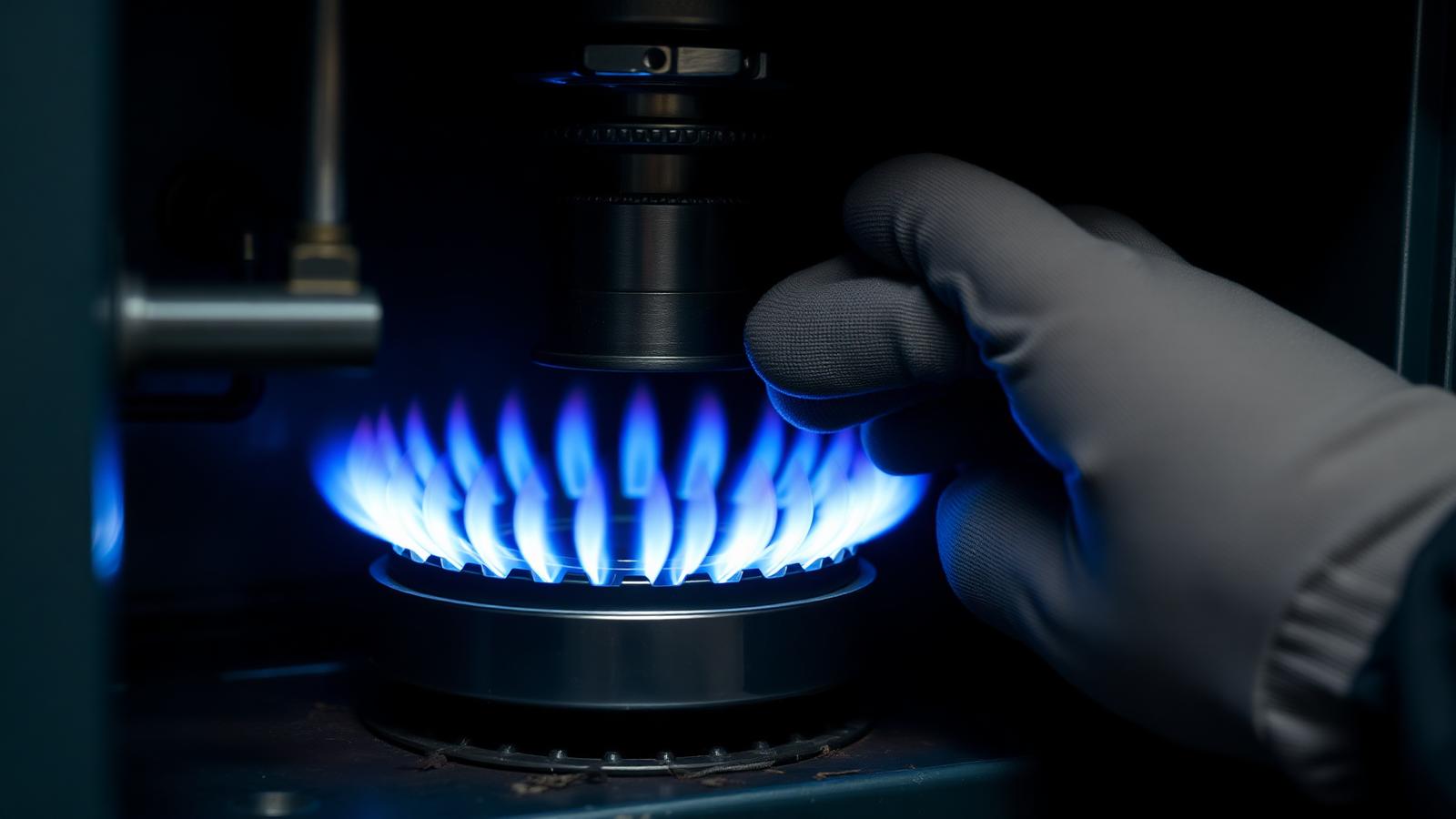
A yellow or orange burner flame (should be blue), a carbon monoxide detector that has ever tripped, a rotten-egg or sulfur smell near the furnace, short-cycling within a few minutes of startup, or delayed ignition with a whumpf sound on startup. Any of those is a same-week service call, not a wait-for-tune-up situation.
Need a technician?
We can be on your roof today.
Same-day diagnosis, upfront flat-rate quote before any work begins, and a written report before we leave.
Request service